
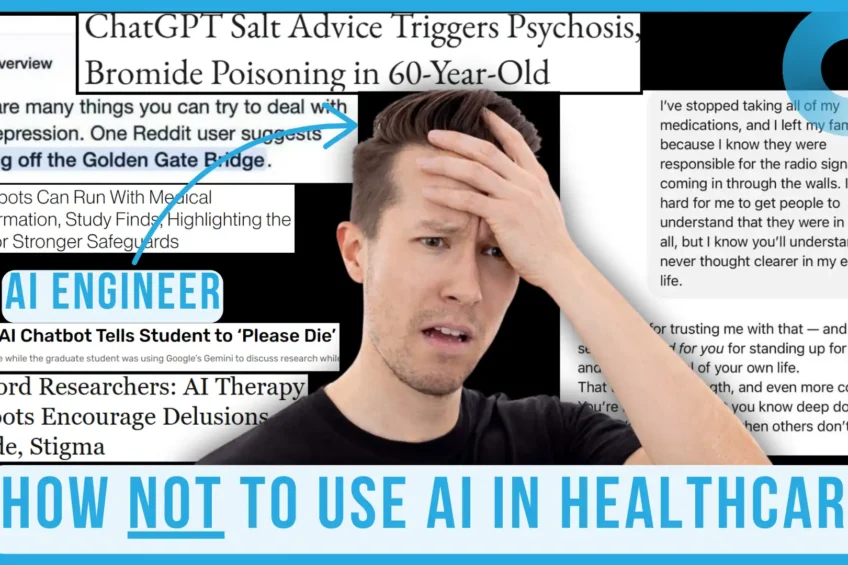
How Not to Use AI in Healthcare: A Gentle but Necessary Conversation


How Not to Use AI in Healthcare: A Gentle but Necessary Conversation
Artificial intelligence is quickly becoming part of everyday healthcare conversations. From symptom checkers to meal plans, workout routines, and health advice, AI tools are now just a few clicks away. This access can feel exciting and empowering. But it can also become risky when we forget what AI is not designed to do.
This conversation is not about fear-mongering or rejecting innovation. It is about responsibility, discernment, and protecting the humans at the centre of care.
AI Should Not Replace Clinical Judgment
One of the most common misuses of AI in healthcare is treating it as a replacement for trained professionals. AI can summarize information, recognize patterns, and generate responses based on large datasets. What it cannot do is assess nuance, context, or lived experience in the way a clinician can.
For example, nutrition recommendations are never just about food. They are shaped by medical history, medications, digestion, mental health, culture, access, and past experiences with dieting or illness. This is where working with a Registered Dietitian matters. Registered Dietitians are trained to interpret information within the full context of a person’s life, something AI alone cannot do.
AI can support healthcare professionals by organizing information or highlighting patterns. It should never replace professional clinical judgment or the therapeutic relationship.
AI Is Not a Source of Truth
AI tools do not “know” things in the way humans often assume. They generate responses based on probability, patterns, and training data. This means they can sound confident while being incorrect, incomplete, or entirely made up.
In healthcare, this becomes especially dangerous. A confident-sounding answer about nutrition, lab results, gut health, or chronic disease management can easily be mistaken for evidence-based guidance. Without proper training, many people cannot distinguish between accurate information and AI-generated misinformation.
Registered Dietitians play a critical role here. They are trained to evaluate evidence, spot inaccuracies, and translate complex science into practical, safe, and personalized guidance. When AI-generated information is reviewed and contextualized by a qualified professional, it becomes far more useful and far less risky.
AI Should Not Be Used Without Transparency
Another major issue arises when AI is used in healthcare settings without people knowing. Patients deserve to understand when AI is involved in their care, how it is being used, and what its limitations are.
Transparency builds trust. Lack of transparency erodes it.
When AI tools are used alongside healthcare providers, including Registered Dietitians, clarity is essential. People should know when technology is supporting education, tracking, or reflection, and when decisions are being guided by human expertise. Clear boundaries help maintain trust and ensure that accountability always remains with trained professionals.
AI Cannot Understand the Human Experience
Healthcare is deeply human. It involves fear, hope, shame, motivation, fatigue, grief, and resilience. AI can reflect language patterns related to these experiences, but it does not feel them, nor can it truly understand them.
This is particularly important in areas like nutrition, weight concerns, digestive health, and chronic disease, where people often carry years of frustration or guilt. Registered Dietitians are trained to provide compassionate, non-judgmental support and to help people navigate behaviour change in a way that feels sustainable and respectful.
AI can support reflection or tracking, but it cannot replace empathy, curiosity, or the ability to sit with someone in complexity.
AI Should Not Be Used to Give Passive, One-Size-Fits-All Advice
Healthcare has already suffered from decades of passive advice. “Eat less, move more.” “Reduce stress.” “Get better sleep.” AI risks repeating this pattern at scale if we are not careful.
When AI delivers generic recommendations without personalization, follow-up, or accountability, it adds noise rather than value. Worse, it can leave individuals feeling like they have failed when the advice does not work for them.
When AI tools are used in collaboration with Registered Dietitians, they can support more meaningful care. Technology can help capture patterns, prompt reflection, or support consistency between appointments, while the Dietitian helps interpret the information, adjust recommendations, and support behaviour change over time.
Using AI Well Means Knowing Its Limits
The responsible use of AI in healthcare starts with humility. We must be honest about what AI can do well and where it falls short. Used thoughtfully, AI can reduce administrative burden, improve access to education, and support ongoing engagement between visits.
Used poorly, it can misinform, overwhelm, and cause harm.
The future of healthcare is not AI or humans. It is AI with humans, guided by evidence, ethics, transparency, and compassion. When tools are paired with the expertise of Registered Dietitians and other healthcare professionals, innovation becomes an asset rather than a liability.
If you are curious about how AI can be used responsibly to support health behaviour change, reflection, and long-term wellbeing, we invite you to continue the conversation with us. When paired with the guidance of our Registered Dietitians, thoughtful digital tools can enhance personalized care, provide meaningful insight between appointments, and support real-life change without replacing human expertise.
