
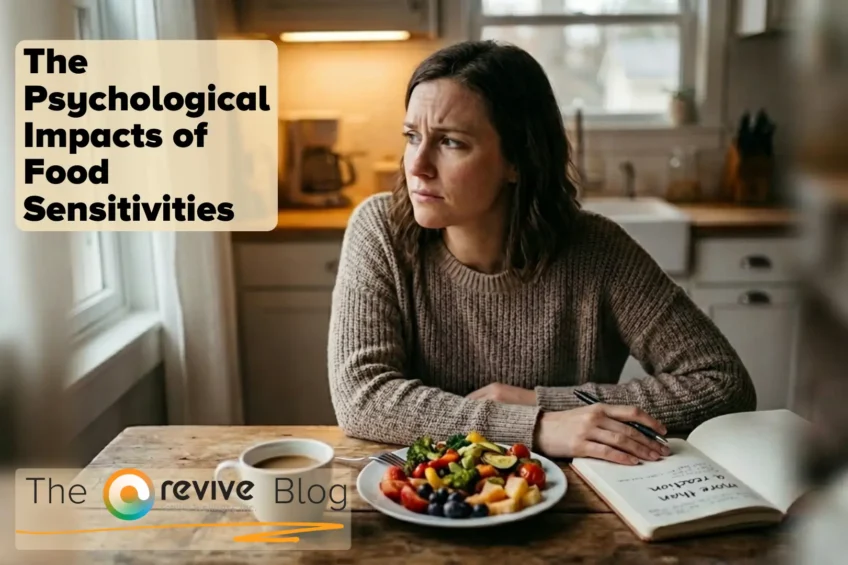
The Psychological Impacts of Food Sensitivities

Coburn et al. describe this middle ground. On the left, little or no concern about food (complacency) can lead people to eat foods that upset them or trigger reactions. On the right, too much worry can lead to constant scanning for “unsafe” foods, avoiding many foods, and increased anxiety, which can lower health-related quality of life. The middle is the goal: paying enough attention to notice patterns and avoid true triggers, while keeping flexibility, social connection, and joy in eating.
This isn’t easy, and it’s very common to feel:
- Anxious about trying new foods
- Frustrated if symptoms keep happening
- Lonely if others don’t understand your experience
If this sounds like you, please know:
You are not alone.
At Revive, we hear you, we see you, and we want to support you in finding a way of eating that feels both comfortable and joyful.
What should I do if I suspect I have a food sensitivity?📝
Everyone’s body and story are different. There is no one plan that works for everyone.
Right now, the gold standard for exploring food sensitivities is a planned elimination diet, done with support from a health professional such as a Registered Dietitian.
An elimination diet usually looks like this:
- Remove certain foods or food groups for a short time
- Slowly add them back in, one at a time
- Watch how your body reacts as you reintroduce foods
This can sometimes help identify patterns and possible triggers.
But even though elimination diets can be helpful, they are not always the right choice for everyone.
When an elimination diet might not be helpful 🚫
For some people, a restrictive diet can be harmful, even if it is short term. This is especially true if you live with or have a history of:
- Eating disorders
- Disordered eating
- Obsessive–compulsive disorder (OCD)
- Strong anxiety or other mental health concerns
In these situations, a restrictive plan may:
- Strengthen strict food rules
- Increase obsessive thoughts about “good” and “bad” foods
- Make it harder to eat in a flexible, relaxed way
- Make social eating and shared meals more stressful
For these reasons, an elimination diet may feel unsafe, triggering, or overwhelming.
Because your gut and brain are always talking to each other, stomach problems can make anxiety or mental health feel worse, and stress can make gut symptoms feel stronger too. This is why protecting your mental health is just as important as managing physical symptoms.
If you have a history of an eating disorder, disordered eating, or anxiety, it’s very important to tell your care team. A supportive, team-based approach with your:
- Doctor
- Mental health provider
- Registered Dietitian
can help you:
- Honour your mental health and recovery
- Avoid unnecessary restriction
- Explore patterns gently, without rigid rules
- Focus on nourishment, safety, and quality of life
What about food sensitivity tests? 🧪
When you don’t feel well, it’s completely understandable to want quick answers. Many people are drawn to blood tests or online “food sensitivity tests” that promise simple solutions.
Often, people hope these tests will:
- Point to exactly which foods to avoid
- Stop uncomfortable GI symptoms
- Give a sense of clarity and control
However, many of these tests are not well-tested or reliable tools for true food sensitivities. They can:
- Give confusing or inconsistent results
- Lead people to cut out many foods they don’t need to avoid
- Increase fear and stress around eating
Instead of bringing peace, they often make the relationship with food more complicated.
A more supportive option is working with a Registered Dietitian who can:
- Take time to understand your symptoms, health history, mental health, lifestyle, and cultural foods
- Help you explore possible triggers in a step-by-step, safe way
- Keep your diet as varied, nourishing, and enjoyable as possible
- Support both your physical and mental health at the same time
You don’t have to do this alone 🤝
Food sensitivities can be exhausting physically, mentally, and emotionally. You deserve care that respects your body, your culture, and your lived experience.
If you’re feeling stuck, overwhelmed, or unsure what to try next, our team at Revive is here to walk beside you.
Book a free 15-minute discovery call with one of our Registered Dietitians to talk through your symptoms and concerns, explore next steps that feel safe for your mental health, and start building a calmer, more confident relationship with food.
👉 Click here to book with Laura
👉 Click here to book with Matthew
👉 Click here to book with Kelsey
Continue reading:
👉 Check out this post by RD Kelsey and RD Laura – Transform Your Health By Nurturing Your Gut
👉 Check out this post by RD Matthew – Eosinophilic Esophagitis (EoE): What Is It and How Can a Dietitian Help?
👉 Check out the different Dietitian services offered by Revive Wellness, including Gut Health session and package information